



The Pause Before Helping: What happens to the child’s brain when parents step back and let their child figure it out on their own?
When your four-year-old struggles to zip their jacket or turns a glass upside-down trying to pour water, your body reacts instantly. Hands reach out. The zipper gets pulled up. The glass is gently taken away.
It stems from love, care, and a natural desire to keep routines moving smoothly. Yet, as we recently discussed in our Parent Education Series, stepping in too quickly can unintentionally interrupt one of the most critical processes in early childhood: the construction of executive function in the developing brain.
Let’s look at what is happening inside your child’s nervous system when they struggle—and why practicing the “Montessori Pause” transforms frustration into long-term self-regulation.
The Neuroscience of the Struggle
When a child encounters a challenge—a shoe that won’t go on, the handles of the shopping basket that keep falling, or a spill on the kitchen floor—their brain enters a state of active problem-solving.
1. Strengthening the Prefrontal Cortex
The prefrontal cortex is the command center for executive function skills: impulse control, working memory, emotional regulation, and flexible thinking. These neural pathways do not wire themselves through success alone; they wire through productive struggle. When a child tries, fails, adjusts, and tries again, their brain builds robust synaptic connections that say: “I am capable of figuring this out.”
2. Developing Myelination Through Repetition
Every time a child independently repeats a physical task, pathways in the motor cortex become wrapped in myelin—an insulating layer of fatty tissue that speeds up electrical signals. Stepping in robs the brain of the specific mechanical repetitions required to turn awkward motor tasks into automatic physical confidence.
3. The Shift from External to Internal Motivation
When adults intervene too quickly, the child’s brain learns to rely on external regulation: “When things get hard, someone fixes it for me.” Allowing the child to reach the end of a task independently triggers a release of dopamine (the brain’s natural reward chemical), reinforcing intrinsic motivation and a strong sense of personal agency.
What to Do Instead: The 4-Step Response Framework
Replacing the urge to rescue requires a clear framework. The next time your child hits a wall of frustration, practice this step-by-step approach:
-
Resist the Urge to Help (The 10-Second Rule)
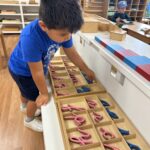
Pause before stepping in. Observe their body language: Are they experiencing productive challenge or distressing overload? Give their brain a moment to process options. This parent does a wonderful job of observing her child and letting her figure it out!
-
Describe What You See (Without Solving It)
Bring neutral language to the moment to help activate their logical brain without taking over the task.
-
“The zipper is caught on the cloth.”
-
“The shoe tongue got pushed down inside.”
-
-
Offer Scaffolding, Not Solutions
Provide the absolute minimum intervention needed to get them over the single point of failure, then step back again.
-
Instead of tying the shoe, hold the tongue back so they can slip their heel in.
-
Instead of wiping up the spill, hand them a cloth and ask, “Where should we start?”
-
-
Acknowledge Effort Over Outcome
Focus feedback on the process to reinforce the neural pathways of perseverance.
-
“You worked on that button for a long time until it went through!”
-
Bringing the Principle Home
Building self-sufficiency isn’t about leaving a child to struggle helplessly; it is about providing the steady, calm presence that allows them to discover their own capability. When we step back, we send a powerful message to our children: I trust you, and your brain is capable of big things.
Parents Often Also Ask…
La Jolla Montessori School
Nurturing calm minds, joyful hearts, and the science of peaceful growth.
You can learn more about our Montessori approach by clicking on each of our programs below:
👉 La Jolla Montessori School’s Nido Program (Ages 6 -24 months), Toddler Program (Ages 18 months – 3 years), and Primary Program (Ages 3–6 years)
The marvelous video featured in this post showing a child ‘figuring it out’ was created by @deddehhoward.